When Optimization Becomes Noise: What 30 Viral Health Trends Reveal
Why doing more “healthy habits” often creates confusion, fatigue, and nervous-system overload — especially for intelligent women.
EMOTIONAL
1/11/20266 min read


When Optimization Becomes Noise: What 30 Viral Health Trends Reveal
Why doing more “healthy habits” often creates confusion, fatigue, and nervous-system overload — especially for intelligent women.
Introduction — The False Promise of Optimization
There is a familiar rhythm many intelligent women recognize immediately. It begins with curiosity and good faith: reading, listening, saving, refining. Health podcasts during walks. Supplements bookmarked. Morning routines adjusted. Sleep protocols optimized. Each addition feels reasonable. Responsible, even.
Nothing here resembles excess. There is no recklessness, no obsession. Only the quiet conviction of someone trying to take care of herself properly — informed, proactive, thoughtful. And yet, over time, something subtle shifts. Instead of clarity, there is friction. Instead of vitality, a low-grade fatigue. Instead of confidence, a sense of internal noise.
The paradox is uncomfortable because it contradicts effort. The more habits added, the less grounded the body feels. The more information consumed, the harder it becomes to sense what is actually working. Health becomes cognitively loud.
This is not a failure of discipline. It is not a lack of motivation or follow-through. And it is not the result of “doing it wrong.” The problem sits elsewhere — in a cultural logic that equates wellbeing with constant optimization, without providing any mechanism for discernment.
When Health Becomes Performance
Viral health culture does not emerge from care; it emerges from visibility. Platforms reward what is demonstrable, extreme enough to notice, and simple enough to replicate. Cold plunges, fasting windows, supplement stacks, morning rituals — all of them compress complex physiological processes into aesthetic, repeatable actions.
In this environment, health is no longer something integrated quietly into a life. It becomes something displayed, tracked, and iterated upon. Practices circulate not because they have been lived with long enough to be understood, but because they photograph well, promise quick returns, or signal seriousness.
The problem is not that these practices are inherently harmful. Many are benign, some genuinely useful. The issue is that they are encountered as isolated units, stripped of context, hierarchy, and individual relevance. They arrive as content, not as care.
Over time, this shifts the internal posture of the person consuming them. Health becomes performative even in private. The body is treated as a project to be improved rather than a system to be listened to. Integration gives way to accumulation.
Why Intelligent Women Are Especially Vulnerable
Intelligent women tend to approach health with the same qualities that serve them elsewhere: conscientiousness, pattern recognition, and moral seriousness. When exposed to compelling information, they do not dismiss it casually. They try to understand it, evaluate it, and — if it seems reasonable — apply it.
This creates a specific vulnerability. Intelligence without an external filtering structure often leads not to discernment, but to over-compliance. When every habit is framed as beneficial, evidence-backed, or “worth trying,” the default response becomes inclusion rather than exclusion.
There is also a moral undertone that quietly amplifies the problem. Effort is interpreted as responsibility. If a practice is said to support longevity, energy, or mental clarity, not adopting it can feel like negligence rather than choice. Over time, health becomes a site of ethical pressure.
The result is not excess enthusiasm, but chronic cognitive engagement. The mind never fully rests from evaluating, tracking, and adjusting. What begins as self-care turns into constant self-monitoring — a state that erodes the very regulation these practices promise to support.
Doing More Is Not the Same as Living Better
Optimization assumes that improvement is additive. One more habit, one more protocol, one more upgrade. But human systems do not operate on linear accumulation. They operate on coherence.
A cold shower may be stabilizing in one context and dysregulating in another. Fasting may feel clarifying until layered on top of intense cognitive work, emotional stress, or insufficient rest. Supplements that are neutral alone can become destabilizing in combination.
Individually, these practices often make sense. Collectively, they create friction. Without hierarchy, the body receives mixed signals. Without rhythm, even beneficial stressors accumulate. Without simplicity, the nervous system remains on alert.
Living better is not about maximizing inputs. It is about reducing internal contradiction. When habits compete rather than support one another, wellbeing becomes fragile — dependent on constant adjustment instead of stable orientation.
The Nervous System Can’t Integrate Endless Input
The body is not a machine that can be endlessly optimized through upgrades. It is a regulatory system that depends on predictability, rhythm, and recovery. When inputs multiply without restraint, regulation becomes difficult — not because the practices are wrong, but because there are too many of them.
Nervous-system health is often misunderstood as resilience: the ability to tolerate more. In reality, regulation depends on the opposite — the capacity to return to baseline. This requires simplicity. Repetition. Familiarity.
When health practices change weekly, when routines are constantly tweaked, when the body is asked to adapt endlessly, exhaustion emerges not as weakness but as signal. It is the nervous system indicating overload, not failure.
In this context, fatigue is not a sign that one needs better habits. It is often a sign that there are too many — and that none of them have been given the time or stability required to integrate.
The Absence of a Filtering System
Modern wellness culture is built around discovery, not discernment. The dominant question is always: What should I add? Rarely is the inverse considered: What should I leave out?
A filtering system is not a list of rules or a rigid philosophy. It is the capacity to decide what is not worth integrating — even if it is popular, evidence-backed, or well-intentioned. Without this capacity, every new insight becomes an obligation.
This pattern becomes especially visible when someone attempts to follow multiple “healthy” practices at once.
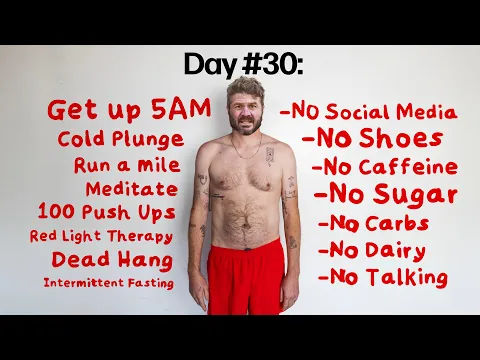
In a recent experiment, a creator tried integrating 30 viral health trends over 30 days — cold exposure, supplements, productivity rituals, fasting protocols, and more.
The result wasn’t clarity or vitality, but information overload: habits that were individually reasonable became collectively destabilizing.
The takeaway wasn’t that these practices are useless — but that without a filtering system, even “good” habits create noise instead of wellbeing.
https://youtu.be/nygR3g0-lts?list=LL
What this reveals is structural, not personal. Exposure is mistaken for integration. Novelty is confused with progress. And the ability to subtract is never taught.
Why Trying Everything Creates Confusion, Not Mastery
Mastery does not emerge from sampling. It emerges from sustained relationship. Practices only become supportive once they are embodied — once the body has learned their rhythm, limits, and effects over time.
Viral health culture rewards novelty, not continuity. This keeps the individual in a perpetual state of experimentation, where nothing is lived with long enough to stabilize. The body becomes a testing ground rather than a home.
Confusion follows not because the person lacks intelligence, but because coherence is impossible under constant change. Without limits, attention fragments. Without commitment, signals blur. What remains is effort without orientation.
At The Muse Guide, this insight is foundational: mastery begins with subtraction. Not because less is morally superior, but because depth requires boundaries.
What Actually Creates Sustainable Wellbeing
Sustainable wellbeing is not built through aspiration. It is built through capacity. What a body can integrate calmly matters more than what it could theoretically tolerate.
Coherence matters more than intensity. A small number of practices that align with one another, repeat predictably, and fit the reality of a life will always outperform an impressive stack that requires constant vigilance.
Integration matters more than novelty. The nervous system does not respond to optimization; it responds to safety. Familiar rhythms signal safety far more reliably than cutting-edge protocols.
These principles are not prescriptive. They do not tell anyone what to do. They simply describe what tends to endure once the noise quiets.
You Don’t Need Better Habits — You Need a Filter
At the center of this entire pattern is a quiet truth: most intelligent women are not lacking information. They are drowning in it.
The next step is rarely another habit. It is the ability to decide what is worth keeping — and what is merely adding cognitive and physiological noise. A filter restores agency without adding effort. It transforms choice from obligation back into design.
This is not about doing less for the sake of minimalism. It is about doing fewer things well enough that the body can actually respond.
A Simpler Way to Decide What’s Worth Integrating
The Habit Filter exists for women who are tired of doing everything “right” and still feeling overwhelmed. It is not a plan, a challenge, or a system to follow. It is a way of thinking that relieves pressure.
For those who recognize themselves in this pattern — the accumulation, the fatigue, the quiet confusion — clarity does not arrive through addition. It arrives through removal.
Download: The Habit Filter
How to decide what’s worth keeping — and what’s just noise.
Conclusion — Clarity Is a Subtractive Skill
Clarity rarely comes from more effort. It comes from limits. Calm is often structural, not emotional. And health is not something chased through constant optimization — it is something designed through discernment.
When optimization becomes noise, intelligence reveals itself differently. Not in the ability to adopt more, but in the courage to subtract.
That, quietly, is where wellbeing begins.